
For many UK businesses, the most practical Citrix alternative is managed Microsoft Remote Desktop Services (RDS) hosted by a UK provider. It delivers the same core result – Windows desktops and applications from any device – without Citrix subscription bundles or cloud-connected licensing, and with the infrastructure, patching and support handled for you.
Quick facts
- The trigger: Citrix ended new perpetual licence sales in 2022, after its acquisition by Cloud Software Group, and now sells subscriptions only.
- The deadline that has passed: file-based Citrix licensing stopped working on 15 April 2026. Activation now runs through Citrix’s cloud-based License Activation Service.
- The channel change: since 1 March 2026, Arrow Electronics has managed all Citrix Service Provider partners across North America and Europe.
- The alternative: managed RDS uses Microsoft’s own remote desktop technology, run for you in a UK data centre.
- The question most buyers miss: where the replacement is hosted, and who owns the provider, decides which law governs your data.
Why are UK businesses looking for a Citrix alternative?
Citrix has been the default for virtual apps and desktops for decades. For large, complex estates it still earns that position. For many small and mid-sized organisations, however, the commercial relationship has changed faster than their needs have.
Since Cloud Software Group took Citrix private in 2022, licensing has been rebuilt around subscriptions and bundled platform editions. Across the market, IT teams report renewal quotes well above what they paid before, sometimes with little notice. For a business that only needs staff to reach a Windows desktop and a handful of line-of-business applications, that is a lot of platform to pay for.
As a result, the question at renewal time has shifted. It is no longer ‘which Citrix bundle do we need?’ It is ‘do we need Citrix, or do we need what Citrix delivers?’
Key takeaway: Most businesses reviewing Citrix are not unhappy with remote desktops. They are reviewing the cost and terms of one particular way of delivering them.
What has changed with Citrix licensing?
Three changes sit behind most Citrix reviews in 2026.
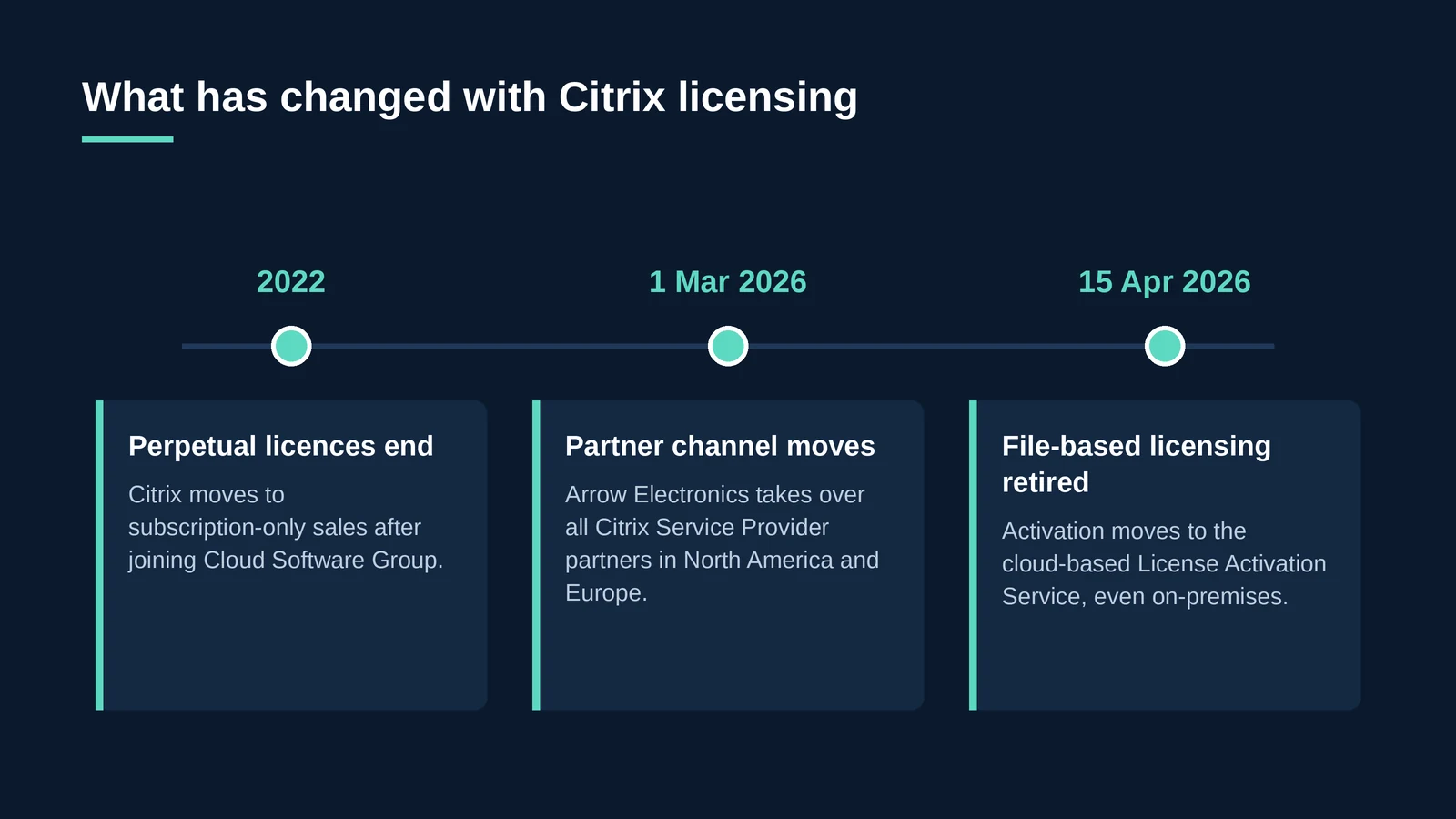
Perpetual licences ended for new sales
Citrix moved to subscription-only sales in 2022. Existing perpetual entitlements remain valid, but they cannot be expanded. In practice, the support renewal is where conversion to a subscription gets raised.
File-based licensing was retired in April 2026
On 15 April 2026, Citrix retired file-based (.lic) licensing. Products now activate through the License Activation Service, which requires connectivity to Citrix Cloud – including environments that run entirely on-premises. For organisations that chose on-premises Citrix to keep everything in-house, that is a significant change.
Service provider partners moved to Arrow
This one matters if you buy Citrix through a managed service provider or a software vendor. From 1 March 2026, Arrow Electronics took over management of all Citrix Service Provider partners in North America and Europe. Citrix still leads product development and technical support. However, your provider’s commercial relationship with Citrix is now different from the one it originally signed up to.
Key takeaway: Subscription-only licensing, cloud-connected activation and a changed partner channel mean many Citrix renewals now involve a new contract, not a continuation of the old one.
Citrix vs managed RDS vs Azure Virtual Desktop: how do they compare?
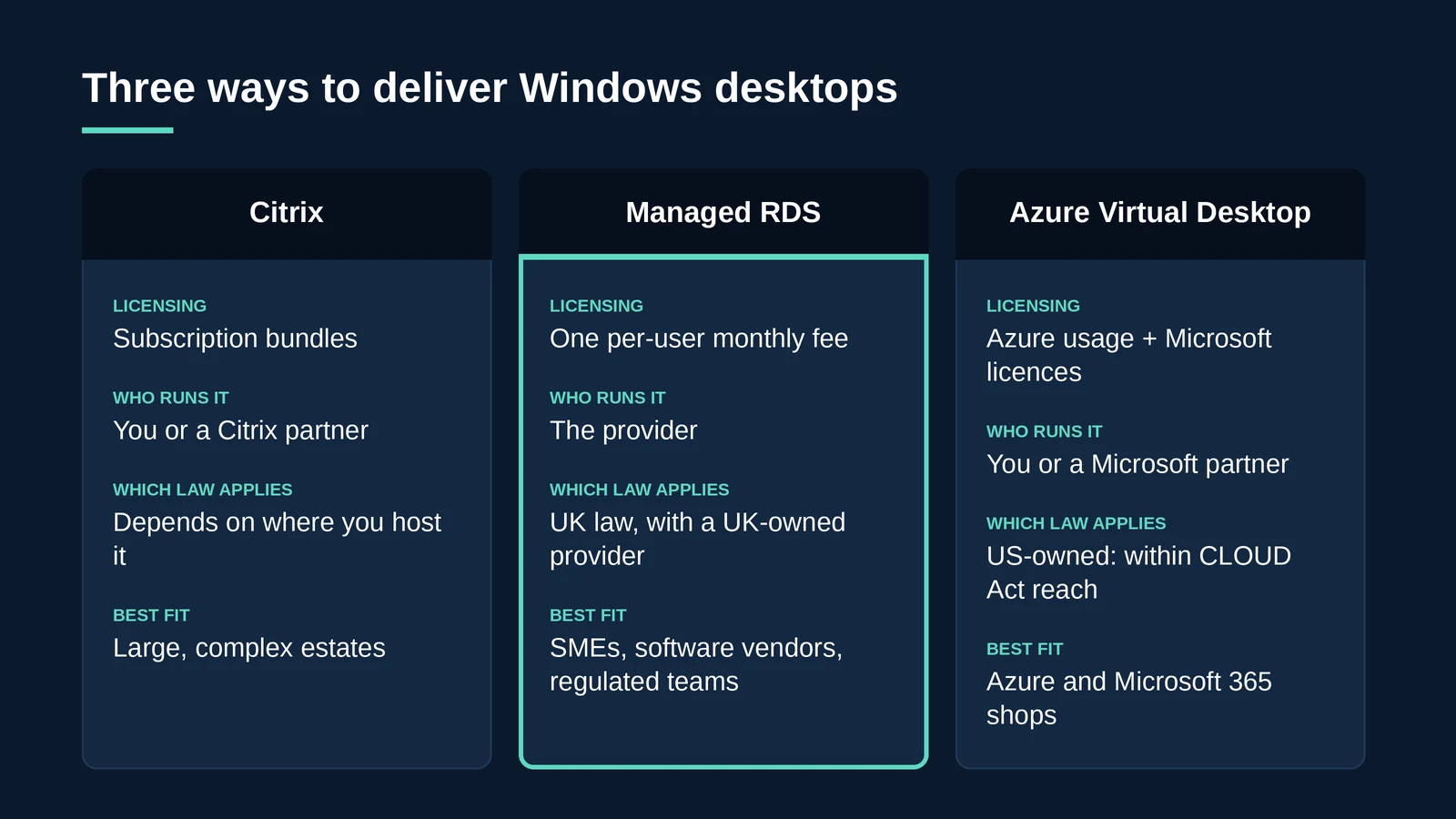
The three options most UK businesses shortlist solve the same problem in different ways. For a wider comparison that also covers DaaS and VPNs, see our guide to RDS vs AVD vs DaaS vs VPN.
| Citrix (Virtual Apps and Desktops / DaaS) | Managed RDS (UK provider) | Azure Virtual Desktop | |
|---|---|---|---|
| Licensing | Subscription only, per user, sold in platform bundles | Usually one per-user monthly fee from the provider | Azure consumption plus eligible Microsoft 365 or Windows licences |
| Who runs it | You, or a Citrix partner | The provider | You, or a Microsoft partner |
| Where data sits | Wherever you deploy it | The provider’s UK data centres | Microsoft Azure regions, including UK South and UK West |
| Which law applies | Depends on hosting; licensing requires Citrix Cloud connectivity | UK law only, if the provider is UK-incorporated with no foreign parent | Microsoft is US-headquartered, so data is within reach of the US CLOUD Act |
| Cost predictability | Set at each renewal | Fixed monthly, depending on the provider | Varies with compute usage |
| Feature depth | Deepest: advanced policies, session recording, graphics tuning | Covers core desktop and application delivery | Strong, including Windows multi-session |
| Best fit | Large, complex estates using advanced Citrix features | SMEs, mid-market, software vendors and regulated teams | Organisations already committed to Azure and Microsoft 365 |
One point is often overlooked. Citrix Virtual Apps has traditionally run on top of Microsoft’s own Windows Server session hosts, adding its own delivery and management layers. So moving to managed RDS usually removes a layer rather than replacing the Windows platform your applications already run on.
Key takeaway: Citrix offers the most features, AVD the closest Azure integration, and managed RDS the simplest commercial model. The right choice depends on which of those you actually need.
Who should move off Citrix – and who shouldn’t?
The honest answer depends on what you use Citrix for.
Strong candidates for managed RDS
- Small and mid-sized organisations whose users mainly need a standard Windows desktop and business applications.
- Software vendors delivering a Windows application to their customers through Citrix, who want a hosted platform they can run under their own brand.
- Regulated teams in finance, legal and healthcare that need data held centrally in the UK rather than on laptops.
- Businesses facing a renewal they cannot justify, or that want fixed monthly costs instead of multi-year commitments.
Probably better staying on Citrix, for now
- Large estates that rely on advanced Citrix features, such as granular session policies, session recording or heavily tuned graphics delivery for demanding 3D and CAD work.
- Organisations deeply integrated with NetScaler for gateway, load balancing and security across many sites.
- Businesses that have just signed a multi-year Citrix subscription. The time to review is well ahead of the next renewal.
Key takeaway: Managed RDS is the right fit when you need reliable, secure Windows desktops and applications. If you need the full Citrix feature set itself, a like-for-like switch will feel like a downgrade.
What does migrating from Citrix to managed remote desktop involve?
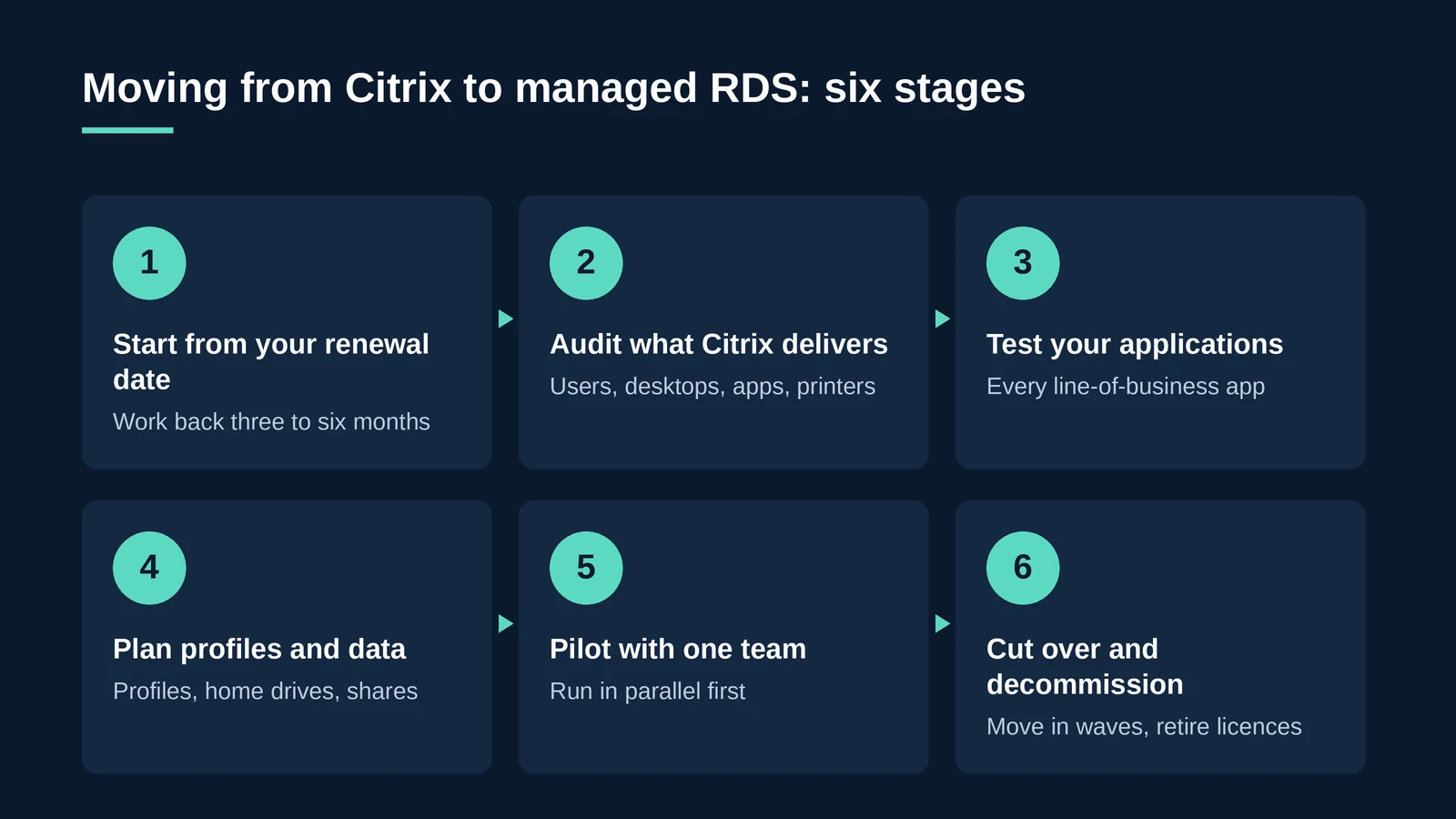
Most migrations follow the same six stages.
- Start from your renewal date. Work back at least three to six months, so the migration never runs up against a licence deadline.
- Audit what Citrix actually delivers. List users, published desktops versus published applications, printers and peripherals, and any Citrix-specific features in daily use.
- Test your applications. Most applications that run under Citrix Virtual Apps already run on Windows Server session hosts, but every line-of-business application should be tested before cutover.
- Plan profiles and data. Decide how user profiles, home drives and shared data will move, and when.
- Pilot with one team. Run a representative group on the new environment in parallel before moving everyone else.
- Cut over and decommission. Move the remaining users in waves, then retire Citrix infrastructure and licences in line with your contract.
Key takeaway: The technical move is usually simpler than the commercial one. The most common mistake is starting too close to the renewal date.
What should you ask a managed remote desktop provider?
Use these questions to compare providers on the things that matter after go-live.
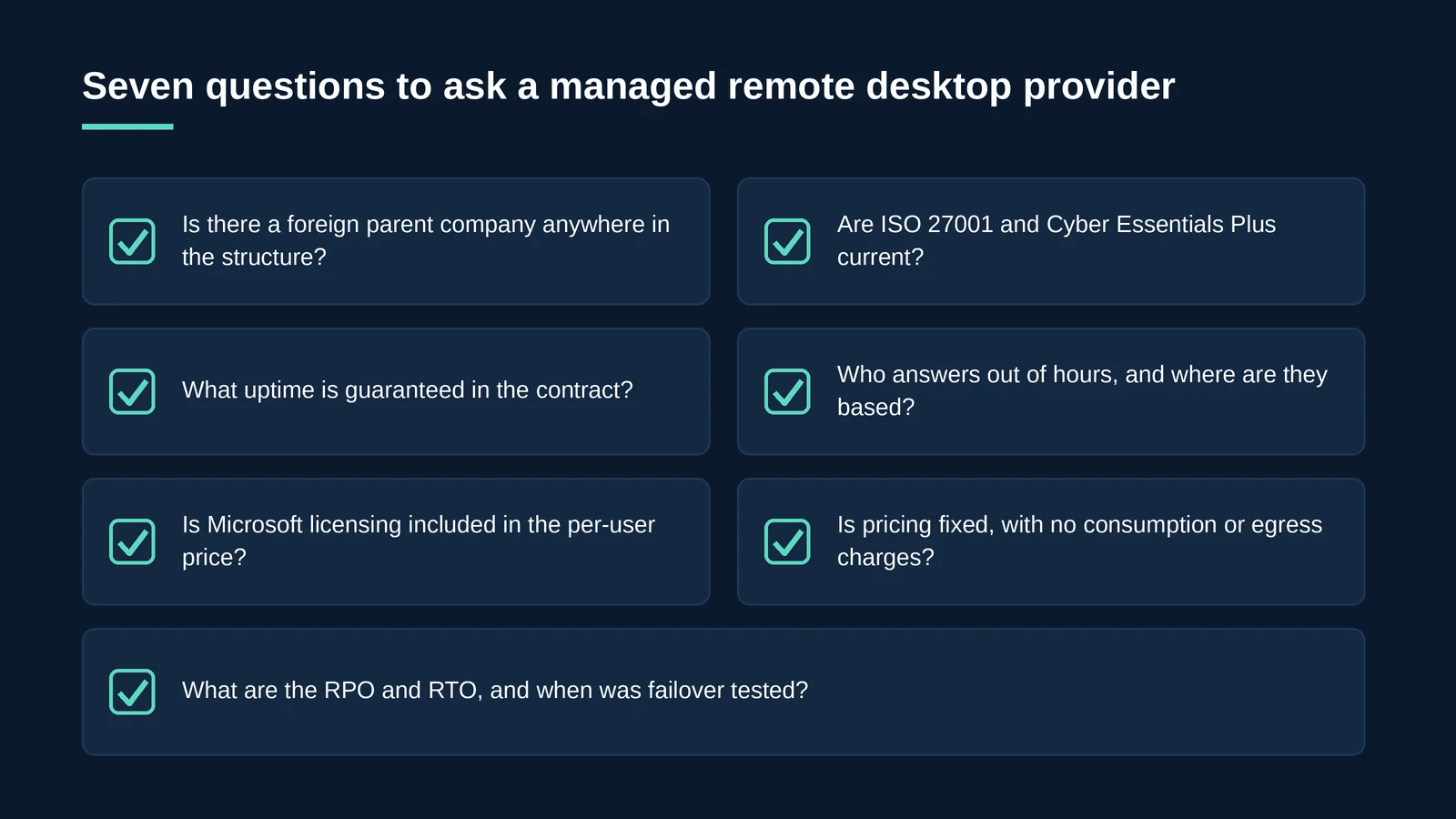
| Requirement | Why it matters | What to ask |
|---|---|---|
| UK data centres and UK ownership | Location decides residency; ownership decides which law can compel access | Is there a foreign parent company anywhere in the structure? |
| Independent certifications | Evidence for your own due diligence and audits | Are ISO 27001 and Cyber Essentials Plus current and independently audited? |
| Contractual uptime | For users, the remote desktop is the whole working day | What uptime is guaranteed in the contract, and how is it measured? |
| UK-based 24/7 support | Login problems happen at 7am, not just in office hours | Who answers out of hours, and where are they based? |
| Microsoft licensing | Hosted RDS must be licensed correctly | Is Microsoft licensing included in the per-user price? |
| Pricing model | Predictable cost is why many businesses leave Citrix | Is pricing fixed per user per month, with no consumption or egress charges? |
| Backup and recovery | A hosted desktop is only as resilient as its recovery plan | What are the RPO and RTO, and when was failover last tested? |
If recovery targets are new territory, our guide to RTO vs RPO explains what to ask for. For sector-specific requirements, see RDS for regulated industries. And for the difference between UK residency and UK sovereignty, read what UK sovereign cloud hosting is.
How does BlackBox support businesses moving off Citrix?
BlackBox Hosting is the UK’s largest managed RDS provider, supporting over 10,000 daily remote desktop users across a wide range of software packages. Its managed Remote Desktop Services run on Microsoft RDS in UK data centres, as a sovereign cloud with no foreign parent company.
- Fully managed RDS: infrastructure, patching, monitoring and support handled by UK-based engineers, 24/7/365.
- White-label RDS for software companies that want to deliver their application to customers under their own brand, plus application publishing for individual apps.
- Fixed monthly pricing with no hidden costs, and a 99.999% uptime guarantee.
- Certified to ISO 27001, ISO 22301, ISO 20000-1, ISO 9001, ISO 14001, ISO 14068-1:2023, CSA STAR Level 2 and Cyber Essentials Plus, and listed on G-Cloud 14.
- A 30-day free trial, so you can test your own applications before committing.
“Most of the businesses we speak to aren’t trying to leave remote desktops behind. They want the same experience for their users without a licensing model that changes at every renewal. For a lot of them, Microsoft’s own remote desktop technology, run properly in a UK data centre, does everything they actually need.”
– Matt Burden, Founder & Managing Director, BlackBox Hosting
Key takeaway: If your Citrix renewal is approaching, test the alternative before you sign. A trial with your own applications will tell you more than any comparison table.
Reviewing your Citrix renewal?
Talk to a BlackBox engineer about moving to managed Remote Desktop Services, or test your applications with a 30-day free trial.
Talk to an expert Start a 30-day free trialFAQ: Citrix alternatives in the UK
There is no single best option for every organisation. For small and mid-sized businesses, and for software vendors publishing Windows applications, managed Microsoft RDS from a UK provider is often the most practical choice. Organisations already built around Azure may prefer Azure Virtual Desktop, while large estates using advanced Citrix features may be better staying put.
No. Citrix ended new perpetual licence sales in 2022 and now sells subscriptions only. Existing perpetual entitlements remain valid but cannot be expanded, and the end of file-based licensing in April 2026 pushes remaining estates further towards subscription.
Citrix retired file-based (.lic) licensing on 15 April 2026. Products now activate through the cloud-based License Activation Service, which needs connectivity to Citrix Cloud, even for on-premises deployments.
Yes, when it is configured and managed properly. A secure RDS environment uses a remote desktop gateway, encrypted connections, multi-factor authentication, regular patching and continuous monitoring. With a managed service, the provider is responsible for keeping those controls in place.
It depends on the number of users, applications and sites. Small environments can often move in a matter of weeks, while larger estates are usually migrated in phases over several months. Starting three to six months before your renewal date avoids working against a licence deadline.
Azure Virtual Desktop can run in Microsoft’s UK regions, which keeps data resident in the UK. However, Microsoft is a US-headquartered company, so data it holds remains within reach of the US CLOUD Act. A UK-incorporated provider with no foreign parent company removes that exposure.
Yes. Many software vendors use managed RDS to deliver their Windows application to customers as a hosted service. BlackBox offers white-label RDS and application publishing, so customers access the software under the vendor’s own brand.