
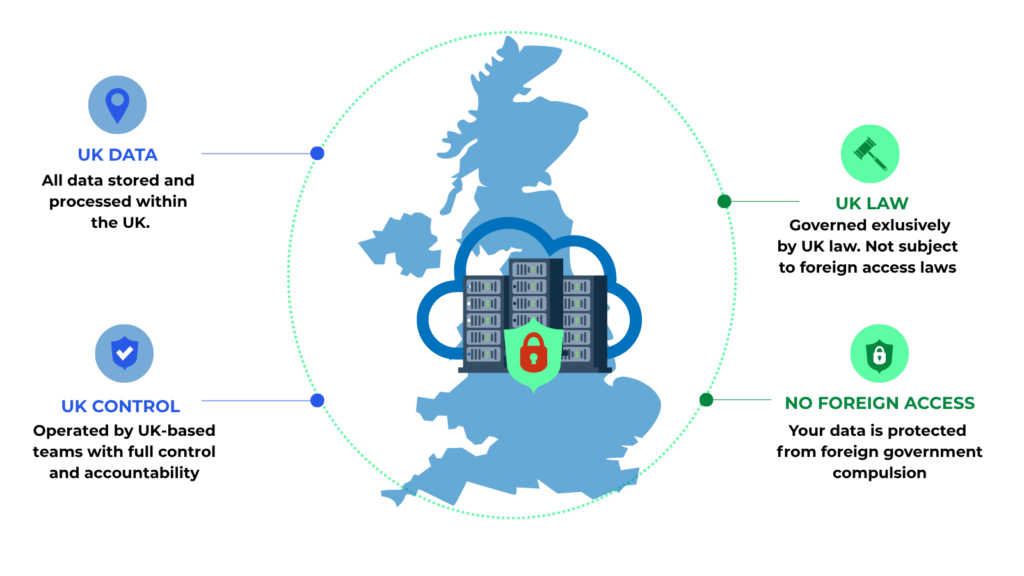
Sovereign cloud hosting is a model of cloud infrastructure where all data, operations, and legal governance remain entirely within UK jurisdiction.
Unlike public cloud platforms from US providers such as AWS, Azure, and Google Cloud, a UK sovereign cloud provider cannot be compelled to hand over your data to foreign governments.
For UK businesses in regulated sectors, such as financial services, healthcare, legal, and public sector – sovereign cloud is increasingly a compliance requirement, not simply a preference.
Quick Reference: UK Sovereign Cloud Hosting
- Definition: Cloud infrastructure where data, operations, and governance remain entirely within UK jurisdiction.
- Key legal protection: Shields data from the US CLOUD Act, FISA 702, and equivalent foreign access laws.
- Primary requirement drivers: UK GDPR, NHS DSPT, FCA PS21/3, G-Cloud procurement rules.
- Who needs it: Financial services, healthcare, legal, public sector, and any business handling sensitive client data.
- Key certifications: ISO 27001, Cyber Essentials Plus, CSA STAR Level 2, G-Cloud listing.
Data Sovereignty vs Data Residency: What’s the Difference?
These two terms are frequently confused and the distinction is critical.
Data residency means your data is stored in a specific country. A US cloud provider with a UK data centre offers data residency.
Data sovereignty means your data is subject to the laws and governance of a specific country. This requires the provider itself to be incorporated and operated under that country’s law – not just hosting servers there.
A UK sovereign cloud provider offers both. A US hyperscaler with UK servers offers residency only and remains subject to US law regardless of where the data physically sits.
Key takeaway: Data residency = where your data is stored. Data sovereignty = which country’s laws govern it. Only a UK-incorporated provider delivers both.
What Makes a Cloud Service Truly Sovereign? The Three Criteria
The term “sovereign cloud” has a precise technical and legal meaning. A cloud service qualifies as sovereign only when all three of the following conditions are met:
1. Data Residency
All data – primary storage, backups, and disaster recovery replication is stored and processed within the UK. No data crosses UK borders.
2. Operational Control
The infrastructure is operated exclusively by UK-based staff, subject to UK employment and security law, with no parent company headquartered in a foreign jurisdiction that could compel data access.
3. Legal Jurisdiction
The provider operates solely under UK law and is not subject to extraterritorial legislation – including the US CLOUD Act, US FISA 702, or equivalent foreign statutes that permit government access to data without UK judicial oversight.
This is the critical distinction from a “UK region” offered by a US hyperscaler. AWS, Azure, and Google Cloud all operate UK data centres, but as US-incorporated companies, they remain subject to US law. American federal authorities can compel these providers to hand over data stored on UK servers, without notifying the customer.
Key takeaway: Sovereign cloud = UK data + UK operations + UK law. A UK region from a US provider is not sovereign cloud.
Why UK Businesses Are Moving to Sovereign Cloud: The Regulatory Drivers
The case for sovereign cloud adoption is driven by specific, enforceable regulatory obligations – not general data security preferences.
UK GDPR and ICO Enforcement
UK GDPR restricts the transfer of personal data to countries that lack adequate data protection standards. Using a US-headquartered cloud provider creates a structural legal exposure: the provider is subject to US law, which does not provide equivalent protections to UK GDPR.
ICO enforcement actions and evolving client contract requirements are making this exposure increasingly difficult to manage. A UK sovereign cloud provider eliminates it entirely: the data never leaves UK jurisdiction, and no international transfer safeguards are required.
The US CLOUD Act
The Clarifying Lawful Overseas Use of Data (CLOUD) Act, enacted in 2018, allows US federal law enforcement to compel US-based cloud providers to hand over customer data, regardless of where in the world it is stored. A company using AWS, Azure, or Google Cloud on UK servers remains exposed to this legislation.
A UK-incorporated, UK-operated sovereign cloud provider is not subject to the CLOUD Act. There is no US parent company through which a compelled disclosure could be made.
NHS DSPT and Healthcare
NHS organisations and their supply chain partners must comply with the NHS Data Security and Protection Toolkit (DSPT). This requires demonstrable, auditable control over where patient data is stored and processed. Sovereign cloud provides a clean answer: data is stored within UK borders, operated by UK staff, under UK law.
FCA Operational Resilience and PS21/3
The FCA’s outsourcing and third-party risk management policy (PS21/3) requires UK financial services firms to maintain meaningful control over critical systems and data. Sovereign cloud directly supports these obligations by keeping both data and operational governance within the UK regulatory perimeter.
The UK DPDI Act
The UK Data Protection and Digital Information (DPDI) Act introduces updates to the UK’s data protection framework, including changes to adequacy decisions and international transfer mechanisms. For businesses already managing complex cross-border data flows, sovereign cloud simplifies compliance by removing the international transfer question entirely.
Key takeaway: UK GDPR, NHS DSPT, FCA PS21/3, and the US CLOUD Act all create specific, enforceable reasons why a UK-incorporated cloud provider operating under UK law is the compliant choice.
UK Sovereign Cloud vs Public Cloud: A Direct Comparison
The core difference is jurisdiction. With sovereign cloud, your data is governed by UK law. With public cloud from a US provider, it is not – regardless of which region you select.
| Feature | UK Sovereign Cloud | Public Cloud (AWS / Azure / GCP) |
|---|---|---|
| Data location | UK only – all primary, backup, and replication | UK region available, not guaranteed by default |
| Legal jurisdiction | UK law only | Subject to US CLOUD Act and extraterritorial laws |
| Foreign access risk | None – not subject to foreign government compulsion | US authorities can compel access to UK-hosted data |
| UK GDPR compliance | Clean – no international transfer issues | Requires ongoing contractual safeguards |
| NHS DSPT | Clear data lineage within UK borders | Requires additional controls and audit evidence |
| Performance | Dedicated UK infrastructure | Shared global infrastructure; variable performance |
| Pricing model | Fixed monthly – no egress fees | Variable usage-based; egress costs accumulate |
| Support | UK-based engineers, direct accountability | Global support tiers, ticket queues |
| Certifications | ISO 27001, CSA STAR, Cyber Essentials Plus, G-Cloud | Varies by provider and region |
Key takeaway: A UK region from AWS or Azure provides data residency. It does not provide data sovereignty. The legal control remains in the US.
Which Industries Need UK Sovereign Cloud Hosting?
Sovereign cloud is not a niche requirement for government agencies alone. Any UK organisation that handles sensitive data, operates in a regulated sector, or holds contractual obligations around data residency should conduct a formal assessment.
- Financial services and fintech – FCA outsourcing rules (PS21/3), client money regulations, and confidentiality obligations under FCA COBS.
- Healthcare and life sciences – NHS DSPT compliance, CQC requirements, patient data confidentiality.
- Legal and professional services – Legal professional privilege, SRA data handling obligations, client confidentiality duties.
- Public sector and central government – G-Cloud compliance, PSN requirements, handling of sensitive citizen and government data.
- Software and SaaS companies serving regulated industries – ISVs hosting client data in financial services, healthcare, or legal verticals carry their clients’ compliance obligations by proxy.
- Any business currently using AWS, Azure, or GCP – if you have not assessed your US CLOUD Act exposure, you have an unquantified legal risk.
Key takeaway: If your business stores, processes, or transmits data on behalf of clients in regulated industries or if you’re subject to UK GDPR, NHS DSPT, or FCA rules – sovereign cloud is worth a serious assessment.
What to Look for in a UK Sovereign Cloud Provider: 9 Essential Criteria
Not every provider that markets itself as “UK cloud” is genuinely sovereign. These are the criteria that distinguish a substantive claim from a marketing label.
| Criterion | What It Means | Why It Matters |
|---|---|---|
| UK incorporation and ownership | Registered in England; no foreign parent company | Prevents foreign law applying to your data |
| ISO 27001 | Independently audited information security management | Baseline for regulated sector procurement |
| CSA STAR Level 2 | Cloud-specific security assurance, independently audited | Confirms cloud security practices, not just general IT |
| Cyber Essentials Plus | UK government-backed cyber security certification | Required for NHS and public sector contracts |
| G-Cloud listing | Listed on Crown Commercial Service Digital Marketplace | Required to supply public sector bodies |
| ISO 22301 | Business continuity management certification | Demonstrates resilience planning beyond uptime SLAs |
| UK-only data centres | Primary, backup, and DR all in UK facilities | Confirms data residency across all copies of your data |
| Tier 3+ data centre | 99.982%+ uptime by design; N+1 or better power redundancy | Enterprise-grade resilience |
| UK-based support team | Engineers and account management in the UK | Direct accountability; no overseas handoffs |
Key takeaway: Prioritise UK incorporation, comprehensive certifications, UK-only data centres, Tier 3+ redundancy, and a UK-based support team. BlackBox Hosting meets all nine criteria.
How to Migrate to UK Sovereign Cloud: A Practical Starting Point
Migrating from a hyperscaler to a UK sovereign cloud provider is a structured process, not a wholesale rip-and-replace. A typical migration involves four stages:
- Data and workload audit. Identify which systems, databases, and applications are in scope, and map your current data flows and backup requirements.
- Compliance gap analysis. Assess your current exposure under UK GDPR, the US CLOUD Act, and any sector-specific obligations (NHS DSPT, FCA PS21/3).
- Provider evaluation. Validate certifications, data centre locations, ownership structure, and support model against the criteria above.
- Phased migration. Move workloads in priority order, typically beginning with the most compliance-sensitive data. Your provider should supply full scoping, technical breakdowns, and a cutover plan.
A reputable sovereign cloud provider will support this process with pre-migration assessments and trial infrastructure, allowing you to test performance with live workloads before committing.
Key takeaway: A successful migration involves workload audit, compliance gap analysis, provider evaluation, and a phased cutover – supported end-to-end by your provider.
Sovereign Cloud Hosting from BlackBox Hosting
BlackBox Hosting is a UK-incorporated managed private cloud provider operating from Tier 3+ data centres in London. All infrastructure – primary hosting, backup, and disaster recovery is located within the UK. The company has no foreign parent company and operates entirely under UK law.
- Tier 3+ UK data centres with N+3 power redundancy and 99.999% network uptime guarantee.
- Certified to ISO 27001, ISO 22301, ISO 9001, ISO 14001, ISO 20000-1, CSA STAR Level 2, and Cyber Essentials Plus.
- G-Cloud listed on the Crown Commercial Service Digital Marketplace.
- Carbon neutral certified under ISO 14068-1:2023, powered by 100% carbon neutral energy.
- Fixed, transparent monthly pricing with no egress fees – independent benchmarking against AWS and against Azure shows up to 50% lower cost.
- UK-based support team providing 24/7/365 monitoring and 4-hour hardware replacement SLA.
- 30-day free trial available – test the infrastructure with your own workloads before committing.
“Sovereignty isn’t just about where the data sits. It’s about who controls it, who can access it, and what law governs it. We built BlackBox from the ground up to answer all three of those questions with ‘the UK’.”
Matt Burden, Founder & Managing Director, BlackBox Hosting
See how UK businesses across regulated sectors have made the move – read BlackBox client case studies.
Frequently Asked Questions
What is sovereign cloud hosting in the UK?
Sovereign cloud hosting is a cloud infrastructure model where all data, operations, and governance remain within UK jurisdiction. The provider is incorporated and operated in the UK, subject only to UK law. This means it cannot be compelled by foreign governments, including under the US CLOUD Act – to disclose customer data.
What is the difference between data sovereignty and data residency?
Data residency means data is physically stored in a specific country. Data sovereignty means data is legally governed by that country’s laws. A US cloud provider with UK servers offers residency, not sovereignty – US law still applies. A UK-incorporated sovereign cloud provider offers both.
Can AWS or Azure provide sovereign cloud hosting?
No. AWS and Azure operate UK data centres, but both are US-incorporated companies subject to the US CLOUD Act. This means US federal authorities can compel them to hand over data stored on UK servers without notifying the customer. Sovereign cloud requires a UK-incorporated, UK-law-only provider.
How does sovereign cloud support UK GDPR compliance?
UK GDPR restricts transfers of personal data outside the UK to countries without adequate protections. Using a UK sovereign cloud provider eliminates international transfer complexity entirely: the data stays within UK jurisdiction, governed by UK law, with no ambiguity about which legal framework applies.
Which certifications should a UK sovereign cloud provider hold?
Look for: ISO 27001 (information security), ISO 22301 (business continuity), Cyber Essentials Plus (UK government cyber security), CSA STAR Level 2 (cloud security assurance), and a G-Cloud listing on the Crown Commercial Service Digital Marketplace. For regulated sectors, also check for ISO 20000-1 and ISO 14001.
What is the difference between sovereign cloud and private cloud?
Private cloud hosting means your infrastructure is not shared with other tenants – you have dedicated resources. Sovereign cloud means your data and operations are confined to a specific legal jurisdiction. A service can be private without being sovereign (for example, a dedicated server in a US-owned facility). The strongest option is infrastructure that is both private and sovereign, which is what BlackBox Hosting delivers.
How much does UK sovereign cloud hosting cost?
Pricing depends on workload size and configuration. UK sovereign cloud providers typically offer fixed monthly pricing with no egress fees – unlike hyperscaler usage-based models where costs are variable and hard to predict. BlackBox Hosting offers a tailored quote and a 30-day free trial for workload testing. Contact the team for a custom quote.
Is BlackBox Hosting G-Cloud listed?
Yes. BlackBox Hosting is listed on the Crown Commercial Service G-Cloud Digital Marketplace, allowing public sector organisations to procure cloud services directly without a separate tender process.
Next Steps
If your organisation is subject to UK GDPR, NHS DSPT, FCA outsourcing rules, or holds data currently hosted with a US cloud provider, a sovereign cloud assessment is a practical next step, not a theoretical exercise.
The BlackBox team can walk through your specific compliance obligations, infrastructure requirements, and migration path. We also offer a free 30-day trial so you can test a fully customised sovereign cloud environment before committing.
Explore UK Sovereign Cloud Hosting
Or speak to the team directly | Call 020 3740 7840