
The Cyber Security and Resilience Bill updates the UK’s NIS Regulations and, for the first time, brings medium and large managed service providers and data centres into cyber security regulation. If your business relies on a hosting or managed service provider, the Bill raises the standard you should expect from them and changes what you should ask before you sign.
Quick facts
- What it is: the Cyber Security and Resilience (Network and Information Systems) Bill, introduced to Parliament on 12 November 2025.
- What it changes: it reforms the Network and Information Systems (NIS) Regulations 2018, the UK’s only cross-sector cyber security law.
- Who is newly in scope: data centres, medium and large managed service providers, large load controllers and suppliers designated as critical.
- Faster reporting: significant incidents need an initial notification within 24 hours and a fuller report within 72 hours.
- Customers get told: data centres, digital service providers and managed service providers will have to inform customers likely to be affected by an incident.
What is the Cyber Security and Resilience Bill?
The Bill is the UK government’s update to the NIS Regulations 2018. Those regulations place security and incident reporting duties on organisations that deliver essential services, such as energy, transport, health, drinking water and digital infrastructure, along with some digital services including cloud computing services.
The government’s case for reform is that attackers have found new routes into essential services. Rather than attacking a hospital or utility directly, they target the managed service providers, data centres and suppliers those organisations depend on. One compromised supplier can disrupt many customers at once.
The Bill responds with three groups of reforms: a wider scope, stronger and more consistent regulators, and new powers for government to respond to emerging threats. Read the government’s summary of the Bill.
Key takeaway: The Bill shifts attention from the organisations delivering essential services to the suppliers behind them, including the companies that host and manage their IT.
Who does the Bill bring into scope?
The Bill keeps existing essential service operators in scope and adds four new groups.
| New category | What it covers | Regulator |
|---|---|---|
| Data centres | Medium and large data centres, and enterprise data centres that meet the thresholds, classed as essential services | Ofcom |
| Managed service providers | Medium and large providers of managed IT services, such as IT outsourcing, helpdesks, infrastructure management and managed security | Information Commissioner |
| Large load controllers | Organisations managing electrical load for smart appliances, such as EV charging | DESNZ and Ofgem |
| Designated critical suppliers | Suppliers that regulators designate as critical to essential or digital services | Relevant sector regulator |
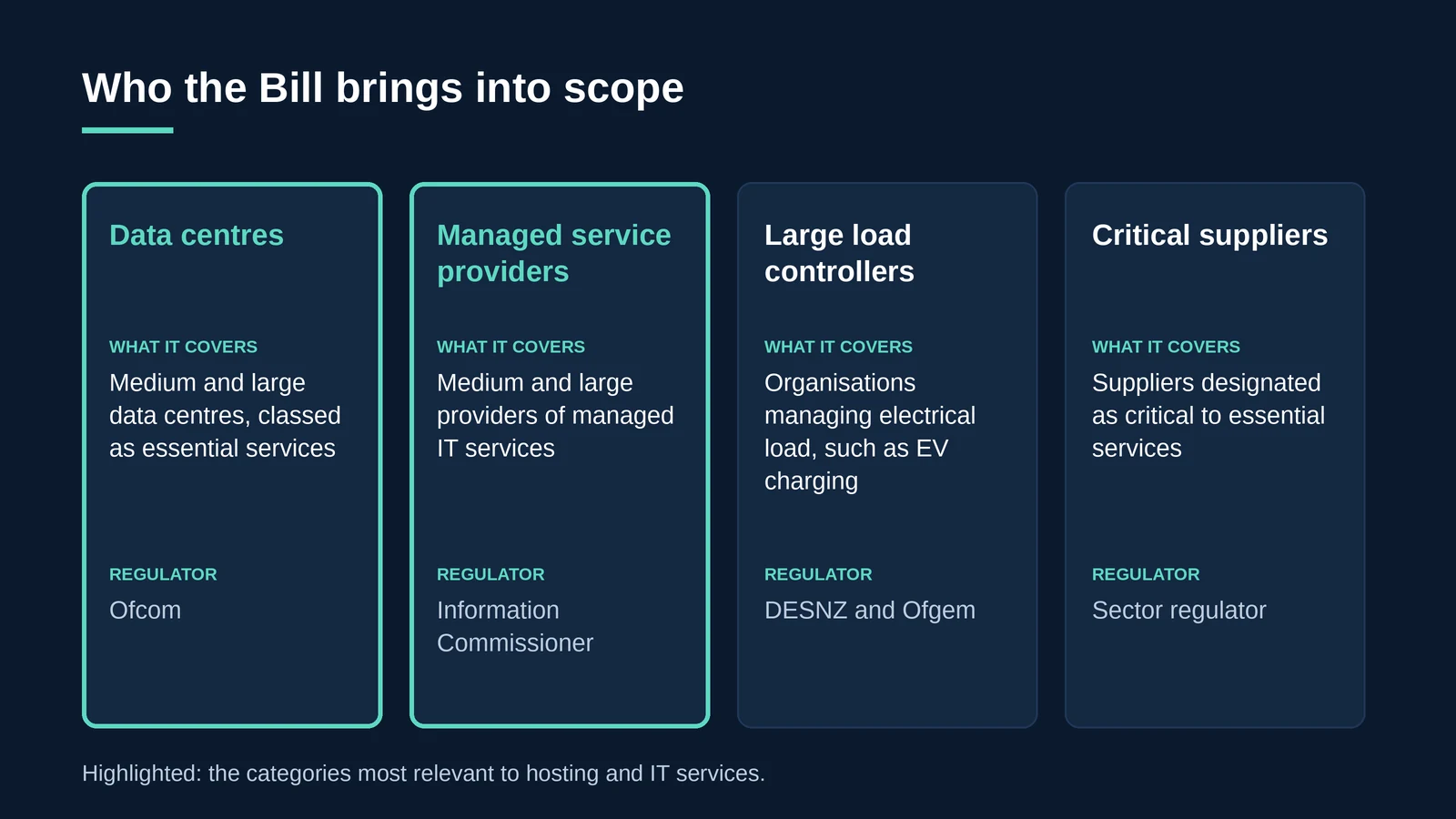
Small and micro businesses are generally excluded from the new managed service provider category. However, the critical supplier power means a smaller supplier can still be brought into the regime if a regulator decides its role is important enough.
Key takeaway: Even if your own business is outside the Bill’s scope, the companies that host and manage your systems may soon be regulated, and that changes what you can reasonably expect from them.
What changes for incident reporting?
Under the current regulations, regulators usually hear about incidents only after they cause significant disruption. The Bill widens this to include harmful incidents that have the potential to cause significant impact, such as attackers sitting inside a network before launching ransomware.
- An initial notification to the regulator within 24 hours, with the National Cyber Security Centre informed at the same time.
- A fuller incident report within 72 hours.
- Data centres, digital service providers and managed service providers must tell customers who are likely to have been affected.
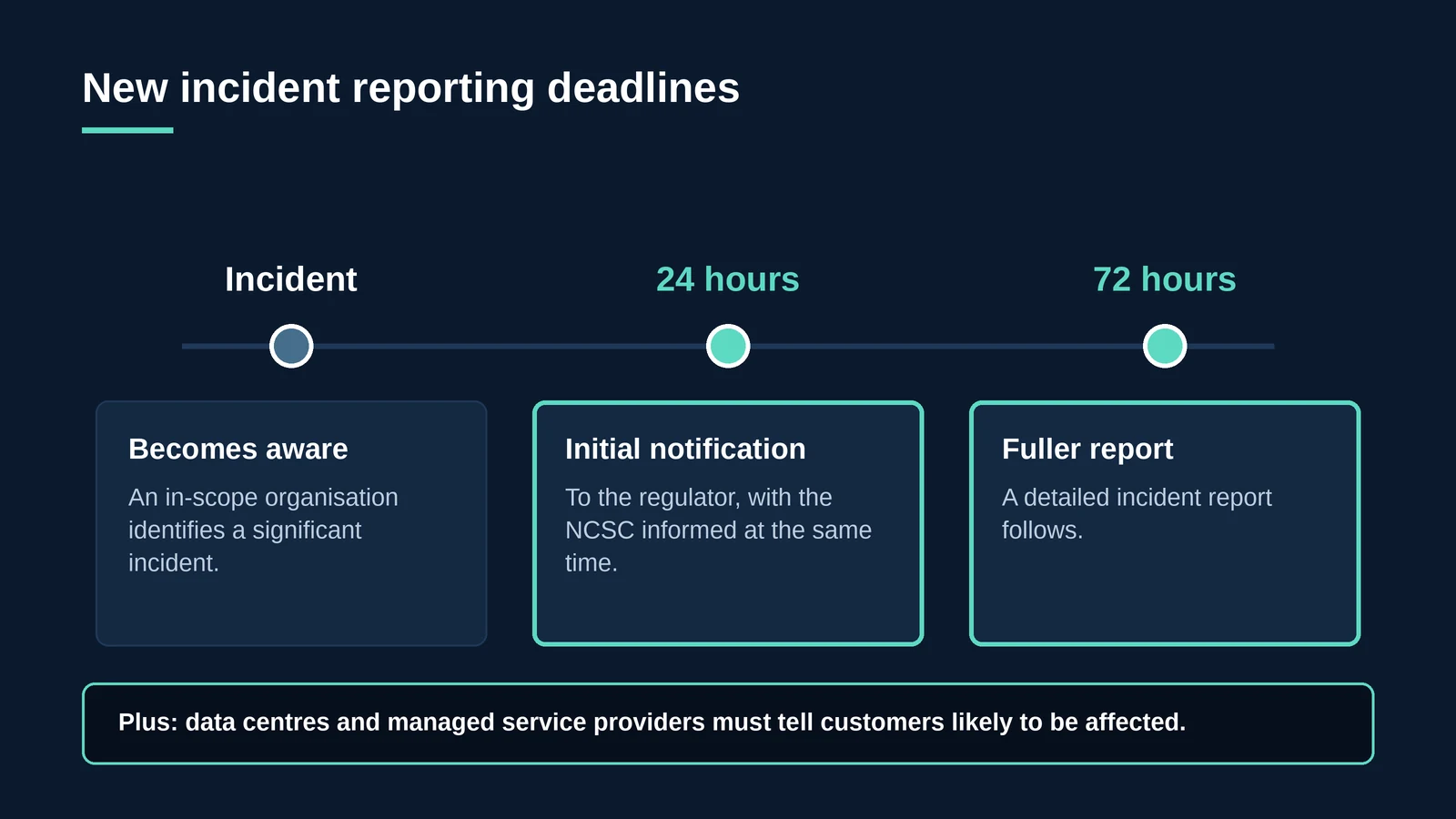
The last point matters most to buyers. If your provider suffers an incident that could affect your data or services, you should hear about it quickly and directly, rather than finding out later.
Key takeaway: Faster, broader reporting means your provider’s incident response process is now a question worth asking before you sign, not after something goes wrong.
When will the Bill apply?
The Bill will come into force in phases once it receives Royal Assent. The government has said businesses will be given an adjustment period before new duties apply.
| Timing | What comes into force |
|---|---|
| Day 1 after Royal Assent | Powers to update the regime through secondary legislation, and the post-implementation review |
| Month 2 after Royal Assent | The statement of strategic priorities for regulators, and information sharing powers |
| Through secondary legislation | Data centres, managed and digital service provider duties, large load controllers, critical suppliers, incident reporting, cost recovery and powers of direction |
Most of the changes that affect hosting and managed service providers depend on secondary legislation, which the government intends to consult on first. The direction is clear, but detailed thresholds and timings may still change.
What does it mean if you buy hosting or managed services?
For most UK businesses, the Bill does not create new legal duties directly. Its effect is indirect: it raises the baseline for the providers you rely on and gives you a clearer standard to measure them against.
- Supplier due diligence gets easier to justify. Asking a provider about its security controls, incident response and resilience is now in line with where regulation is heading.
- Contracts may change. Expect providers to update terms covering incident notification, security measures and cooperation with regulators.
- Regulated customers will push harder. If you supply the NHS, local government or another essential service, your customers may ask you to evidence the security of your own suppliers.
- Certifications carry more weight. Independently audited standards such as ISO 27001, ISO 22301 and Cyber Essentials Plus are a practical way to show that controls exist and are tested.
Compliance and certification are covered in more detail in our guide to why compliance matters when choosing a UK cloud hosting provider.
What should you ask your hosting provider now?
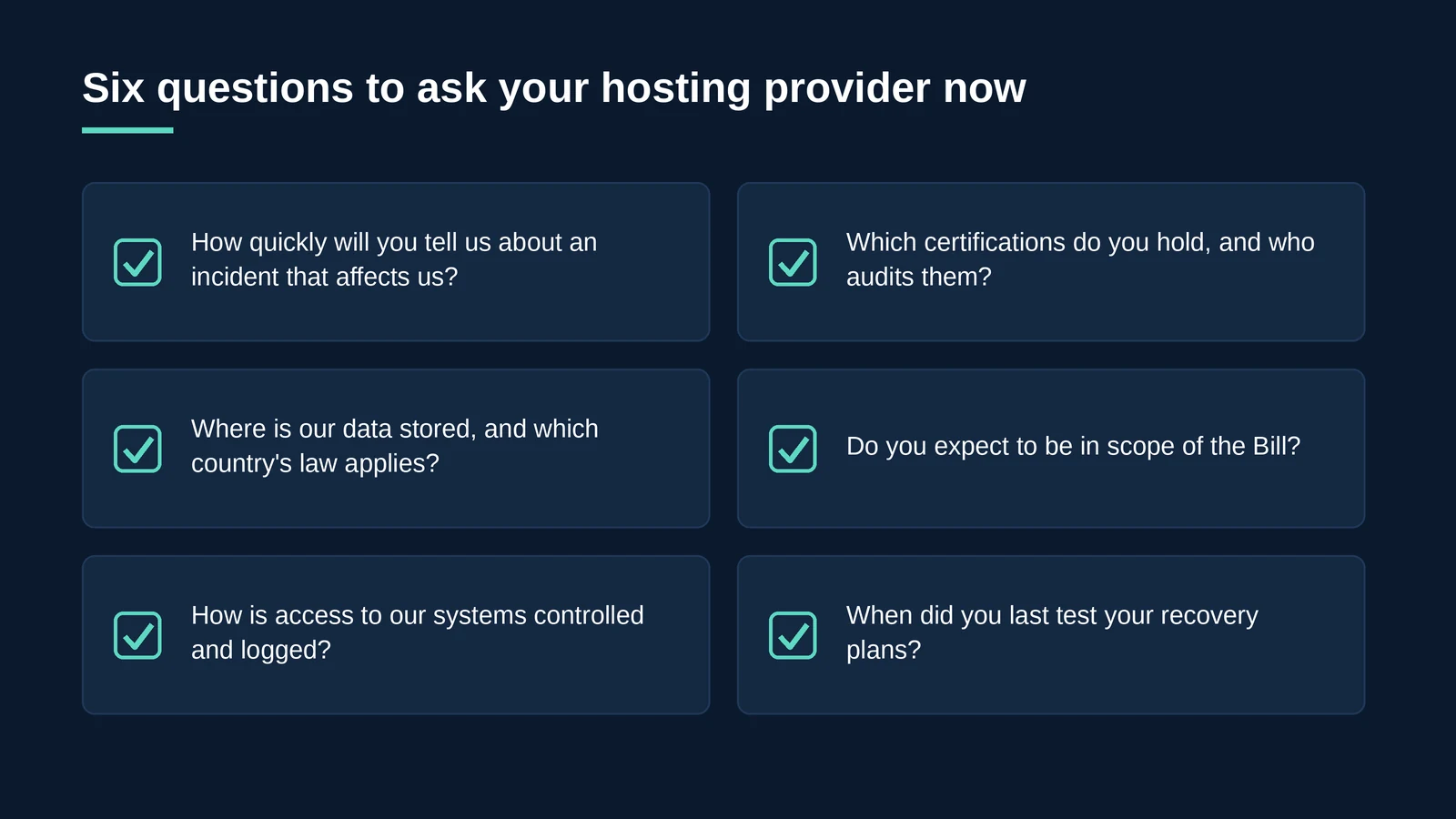
You do not need to wait for the Bill to become law. These questions are worth asking any hosting or managed service provider today.
| Question | Why it matters |
|---|---|
| How quickly will you tell us about an incident that could affect our data or services? | The Bill sets a 24-hour direction of travel for regulators; your contract should set a clear expectation for you |
| Which independent security and continuity certifications do you hold, and who audits them? | Audited certifications are evidence that controls exist and are checked every year |
| Where is our data stored, and which country’s law applies to it? | Location decides residency; ownership decides which governments can compel access |
| Do you expect to be in scope of the Bill, and how are you preparing? | A provider that has considered this is more likely to have mature security processes |
| How is access to our systems controlled and logged? | Managed service providers are targeted because of the access they hold to customer systems |
| When did you last test your business continuity and recovery plans? | Resilience that has never been exercised is a plan, not a capability |
Key takeaway: The best time to ask these questions is before renewal or migration, when you still have leverage to get clear answers written into the contract.
How does BlackBox Hosting support customers?
BlackBox Hosting is a UK-incorporated managed private cloud provider operating from London data centres, with no foreign parent company. Its services are built around the controls the Bill is pushing the market towards.
- Certified to ISO 27001, ISO 22301, ISO 20000-1, ISO 9001, ISO 14001, ISO 14068-1:2023, CSA STAR Level 2 and Cyber Essentials Plus, and listed on G-Cloud 14.
- UK data residency and UK jurisdiction, explained in our guide to UK sovereign cloud hosting.
- 24/7 support from UK-based engineers.
- Managed backup and disaster recovery services to support your own resilience planning.
“The Bill recognises something we’ve seen for years: attackers go after the suppliers because that’s where the access is. Customers are right to ask harder questions of their hosting and managed service providers, and any provider worth working with should welcome them.”
– Matt Burden, Founder & Managing Director, BlackBox Hosting
Reviewing your hosting supplier?
Talk to a BlackBox engineer about UK sovereign hosting backed by independently audited certifications.
Talk to an expert Start a 30-day free trialFAQ: The Cyber Security and Resilience Bill
It is UK legislation that reforms the Network and Information Systems (NIS) Regulations 2018. It widens the regime to cover data centres, medium and large managed service providers, large load controllers and designated critical suppliers, and strengthens incident reporting and enforcement.
The Bill was introduced to the UK Parliament on 12 November 2025. It comes into force in phases after Royal Assent, with many measures depending on secondary legislation and consultation.
Yes. Medium and large managed service providers that meet the definition of a relevant managed service provider will be brought into scope for the first time, with the Information Commissioner as regulator. Small and micro businesses are generally excluded.
Yes. Data centres will be classed as essential services. Medium and large data centres, and enterprise data centres meeting the thresholds, will need appropriate and proportionate security measures, with Ofcom as regulator.
In-scope organisations will need to send an initial notification within 24 hours of becoming aware of a significant incident, followed by a fuller report within 72 hours. Data centres and managed service providers will also need to tell affected customers.
Possibly indirectly. Your hosting and IT providers may become regulated, which will change their contracts and processes. If you supply an essential service, your customers may also ask you for more evidence about the security of your suppliers.
Ask how quickly they will notify you of incidents, which certifications they hold and who audits them, where your data is stored and which law applies, how access to your systems is controlled, and when they last tested their recovery plans.