
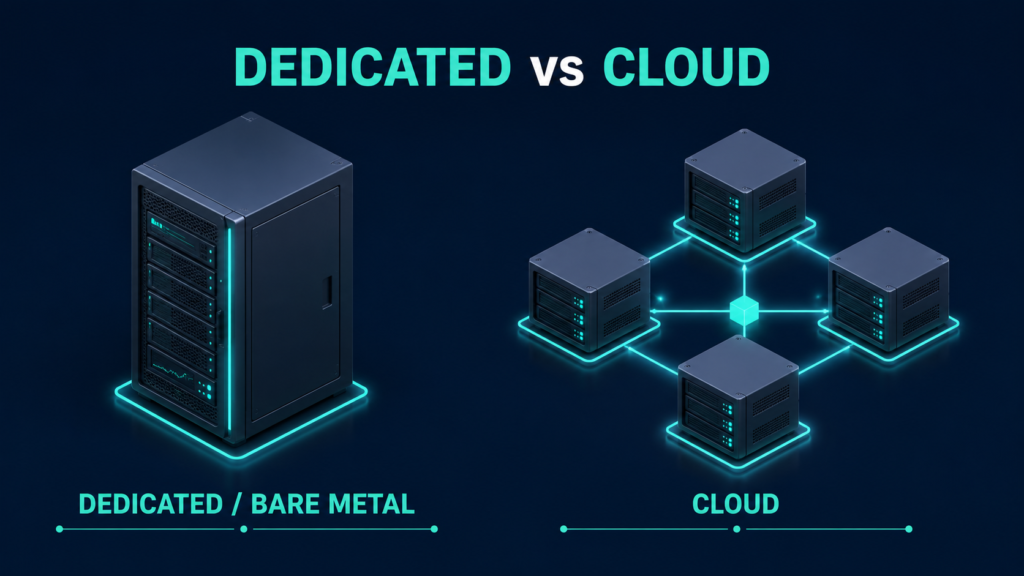
Choosing between a dedicated server and cloud hosting comes down to the shape of your workload, not security alone. A dedicated server (also called bare metal) gives one business a single physical machine for maximum control and consistent performance. Cloud hosting runs on pooled, virtualised resources you can scale on demand. Choose dedicated for predictable, intensive workloads and strict compliance; choose cloud for variable demand and rapid growth.
BlackBox Hosting provides both, fully managed and UK-hosted, from UK-incorporated infrastructure built around UK jurisdiction and compliance.
Quick Reference: Dedicated Servers vs Cloud Hosting
- A dedicated server (bare metal) is single-tenant physical hardware; cloud hosting is pooled, virtualised resource you can scale on demand.
- Dedicated gives consistent performance, full control and fixed, predictable monthly cost.
- Cloud gives near-instant scaling and flexibility, ideal for variable or fast-growing workloads.
- Cloud and VPS platforms are inherently more resilient, running across clustered infrastructure rather than one machine.
- Cost depends on workload shape – cloud is not automatically cheaper for steady, high-utilisation workloads.
- Many UK businesses run a hybrid: a dedicated server for the core, cloud for elastic workloads.
What is the difference between a dedicated server and cloud hosting?
A dedicated server, also called bare metal, is physical hardware – CPU, RAM and storage – assigned to a single organisation. Nothing is shared with anyone else. Cloud hosting abstracts that hardware into a virtualised pool, so resources can be added or removed in minutes rather than days.
The core trade-off is straightforward. A dedicated server gives you raw, predictable performance and total control over a known machine. Cloud hosting gives you elasticity and speed, at the cost of running on shared underlying infrastructure. Both can be UK-hosted and fully managed, so the decision is really about the shape of your workload, not security alone.
Dedicated servers vs cloud hosting: a side-by-side comparison
The clearest way to decide is to compare the two models against the factors that actually affect cost, performance and compliance:
| Factor | Dedicated / bare metal | Cloud hosting |
|---|---|---|
| Resources | Fixed, reserved entirely for you | Pooled and virtualised, scalable on demand |
| Performance | Consistent, no ‘noisy neighbour’ effect | Strong, but can vary with shared infrastructure |
| Resilience | Tied to one machine; failover must be designed and built | Clustered; workloads migrate across nodes automatically |
| Scaling | Vertical: upgrade specs or add nodes | Near-instant, up or down, no hardware changes |
| Cost model | Fixed monthly, predictable | Usage-based or fixed; watch egress and consumption fees |
| Control | Full root and physical control of the machine | Highly configurable; provider manages the hardware |
| Deployment | 24 to 48 hours for standard builds | Minutes to provision |
| Best for | Steady, high-intensity, latency-sensitive workloads | Variable, spiky or fast-growing workloads |
When does a dedicated server make sense?
A dedicated (bare metal) server is the right choice when performance and control matter more than elasticity. It tends to make sense when:
- Your workload is consistently heavy – large databases, high-traffic applications or intensive processing – and you need guaranteed, predictable performance.
- You need full control of the operating system, security patching and configuration, with no platform restrictions.
- You have strict compliance or data-residency requirements and want known, isolated, single-tenant hardware.
- Your demand is steady rather than spiky, so a fixed monthly cost is easier to budget than usage-based billing.
- You run legacy systems that require a specific operating system or environment.
If that describes your environment, bare metal hosting on single-tenant, UK-based hardware gives you the consistency and control to match.
When does cloud hosting make sense?
Cloud hosting wins when flexibility and speed matter more than fixed, dedicated capacity. It tends to make sense when:
- Your demand is variable or seasonal and you need to scale up or down quickly without buying hardware.
- You are growing fast and want to add resources in minutes, not days.
- You are developing, testing and deploying applications that benefit from flexible, isolated environments.
- You want resilience and rapid recovery built in, with the option to scale across pooled resources.
- You would rather avoid a large commitment to one fixed machine specification.
For those workloads, managed UK cloud hosting lets you scale instantly while keeping all data inside UK borders and outside the reach of the US CLOUD Act.
How do dedicated servers and cloud hosting compare for resilience?
Resilience is where the two models differ most, and it is often overlooked. A dedicated server relies on a single physical machine, so if a key component fails – disk, RAM, motherboard or power supply – the service depends on repair or hardware replacement. Even with strong SLAs, that introduces a recovery window.
Cloud and VPS platforms sit on clustered infrastructure rather than a single machine. In practice, workloads can be restarted or migrated onto other nodes, storage is often replicated across multiple systems, and underlying hardware failures are abstracted away from the application layer. The result is higher inherent resilience without needing to design a full high-availability architecture yourself.
Achieving similar resilience on dedicated hardware is possible, but it takes deliberate design: multiple servers, load balancing and failover configuration, and data replication and sync management. That adds both cost and operational complexity. Virtualised and cloud platforms embed much of this capability into the underlying service, reducing the engineering overhead required to achieve comparable uptime.
There is a trade-off. Dedicated servers still have the advantage in consistent, single-tenant performance, but they are tied to one physical system, so under failure or maintenance conditions performance can drop to zero until recovery completes. Cloud and VPS environments are designed to distribute workloads across infrastructure, maintain continuity during hardware events, and scale as demand increases. That makes them well suited to services where availability matters more than absolute single-node performance, such as distributed applications.
Is cloud hosting always cheaper than a dedicated server?
No. Cloud’s pay-as-you-go model often looks cheaper at low or variable usage, but for steady, high-utilisation workloads a dedicated server is frequently more cost-effective – you are not paying a premium for elasticity you never use. Public cloud bills also carry costs that are easy to underestimate: egress (data transfer) charges, consumption penalties and unpredictable monthly invoices.
In BlackBox’s own SQL Server benchmarking, an equivalent private cloud configuration came out around 48% cheaper than AWS while delivering roughly 36% more database throughput (127,271 versus 93,465 NOPM) – a useful reminder that ‘cloud’ and ‘cheaper’ are not automatically the same thing.
Can you combine dedicated servers and cloud hosting?
Yes, and many UK businesses do. A hybrid setup runs a dedicated server for the predictable core (a production database, for example) and uses cloud resources for elastic workloads such as development, testing, seasonal spikes or burst capacity.
That gives you predictable performance where it matters most and flexibility where it helps, all within UK-hosted, compliant infrastructure. The same principle extends to recovery: keeping disaster-recovery data within UK borders keeps a hybrid estate fully compliant. The dedicated-versus-cloud question is rarely a permanent either/or – the right answer often combines both.
What to look for in a hosting provider
Whichever model you choose, the provider around it matters as much as the model itself. Use this checklist when evaluating dedicated or cloud hosting.
| What to check | Why it matters |
|---|---|
| UK incorporation and UK-only data residency | Removes exposure to foreign access legislation such as the US CLOUD Act |
| ISO 27001, Cyber Essentials Plus and CSA STAR Level 2 | Independently audited security and cloud-assurance controls |
| Tier 3+ UK data centres | Resilient, accredited physical infrastructure |
| Clustered cloud and VPS platform | Built-in resilience: workloads migrate if hardware fails, without designing full high availability yourself |
| Single-tenant (bare metal) option | Guarantees performance with no noisy-neighbour effect for dedicated workloads |
| Fixed, transparent pricing | No surprise egress or consumption fees |
| UK-based 24/7 support and clear SLAs | Accountability and fast response when it matters |
Can I get dedicated and cloud hosting from one UK provider?
Yes. BlackBox Hosting provides managed cloud and VPS hosting, with bare metal (dedicated) servers also available, all from a UK-incorporated, UK-operated managed private and sovereign cloud provider built specifically around UK jurisdiction and compliance. Whichever model fits – or a hybrid of both – the surrounding service is the same. The relevant credentials are:
- Managed cloud and VPS hosting that scales on demand, with all data kept within UK borders and outside the reach of the US CLOUD Act.
- Bare metal (dedicated) servers on single-tenant physical hardware, not virtualised, for workloads that need guaranteed, consistent performance and 99.999% uptime.
- Two Tier 3+ UK data centres in London with 24/7/365 UK-based support and a 4-hour hardware replacement SLA.
- UK-only data residency – primary, backup and disaster-recovery data all held within UK borders and governed by UK law.
- Fixed, transparent pricing with no egress fees, consumption penalties or surprise invoices.
- Certifications including ISO 27001, ISO 22301, ISO 20000-1, ISO 9001, ISO 14001, CSA STAR Level 2, and Cyber Essentials Plus.
- Carbon neutral certified under ISO 14068-1:2023 (BSI-verified), powered by 100% carbon neutral energy.
Matt Burden, Founder & Managing Director, BlackBox Hosting
Frequently asked questions
Is a dedicated server faster than cloud hosting?
A dedicated server delivers more consistent performance because its resources are not shared, so there is no ‘noisy neighbour’ effect. Cloud hosting can be very fast, but performance may vary with the shared underlying platform. For steady, high-intensity workloads, dedicated usually wins on predictability.
Is cloud hosting cheaper than a dedicated server?
Not always. Cloud is often cheaper for low or variable usage, but for steady, high-utilisation workloads a fixed-price dedicated server can cost less overall, especially once egress and consumption fees on public cloud are taken into account.
Can a dedicated server scale like the cloud?
Dedicated servers scale vertically (upgrading specifications) or by adding nodes, which is slower than the cloud’s near-instant scaling. If you expect rapid or unpredictable growth, cloud hosting or a hybrid setup offers more flexibility.
Which is more secure, a dedicated server or cloud hosting?
Both can be highly secure. Security depends more on the provider’s certifications, data residency and controls than on the model itself. BlackBox hosts both in ISO 27001-certified, Tier 3+ UK data centres.
What is the difference between cloud hosting and a VPS?
A VPS is a single virtualised slice of one physical server with fixed resources. Cloud hosting draws on a pool of resources across infrastructure, so it scales more flexibly. A dedicated or bare metal server, by contrast, is a whole physical machine reserved for you.
Are dedicated servers and cloud hosting GDPR compliant?
They can be, provided data stays within the UK and is governed by UK law. BlackBox keeps all data in UK-based, ISO 27001-certified data centres with no offshore routing and no exposure to the US CLOUD Act.
Can I move from a dedicated server to cloud hosting later?
Yes. A managed UK provider can plan and run the migration with minimal downtime, and many businesses move between models, or run both, as their needs change.
Choosing the right hosting model
The dedicated-versus-cloud decision is rarely about which is better in the abstract. It comes down to workload shape, budget predictability, resilience needs and where your data has to live. Steady, intensive, compliance-bound workloads favour dedicated bare metal; variable, fast-growing or distributed workloads favour cloud; and many estates are best served by a hybrid of both.
BlackBox Hosting provides both from UK-only, fully certified infrastructure. Speak to the team to discuss your workload, compliance obligations and the right mix of dedicated and cloud for your business.