
Microsoft is raising Azure prices from 1 February 2027. Virtual machines and most storage in seven regions, including Dublin and Amsterdam, go up by 8% to 17%, and older v1 and v2 VM series rise by around 25% in every region worldwide. UK regions are not on the regional list, but many UK businesses will still pay more.
What exactly is Microsoft increasing in February 2027?
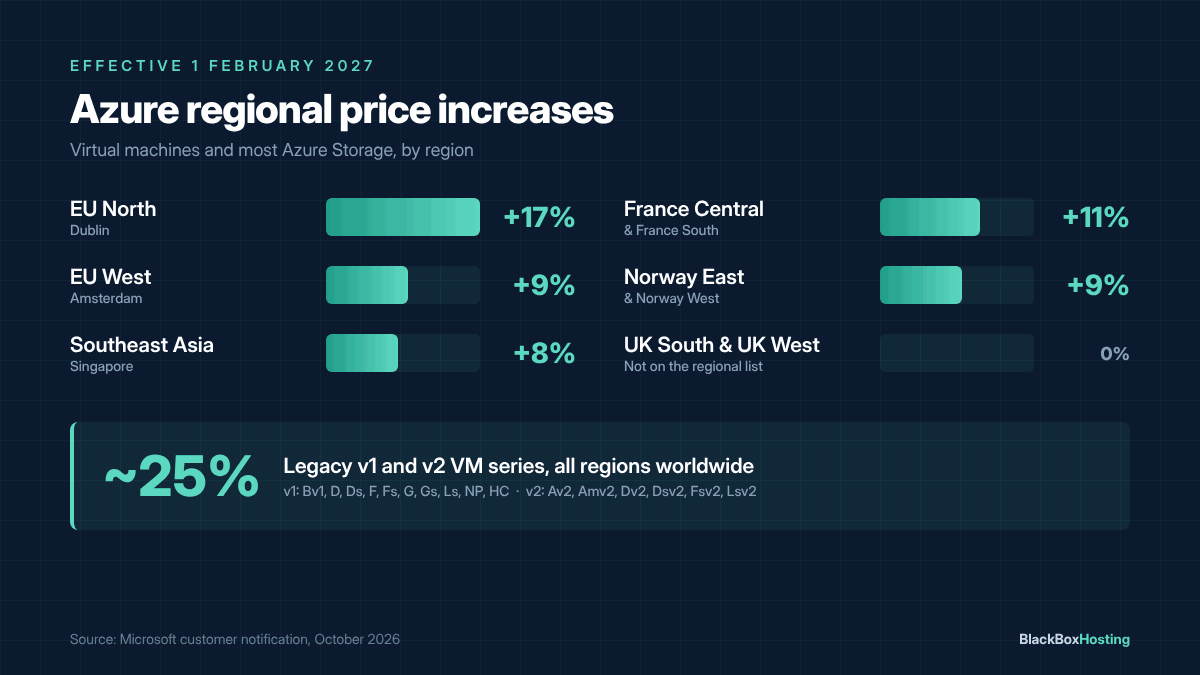
There are two separate increases, and they do not overlap. The first is regional: VM and most Azure Storage pricing rises in seven regions, with the size of the increase depending on the region. The second is global: the oldest VM series, known as v1 and v2, rise by roughly 25% in all regions.
| Change | Applies to | Increase |
|---|---|---|
| Regional VM and storage pricing | EU North (Dublin) | +17% |
| France Central, France South | +11% | |
| EU West (Amsterdam) | +9% | |
| Norway East, Norway West | +9% | |
| Southeast Asia (Singapore) | +8% | |
| Legacy VM series | v1: Bv1, D, Ds, F, Fs, G, Gs, Ls, NP, HC | About 25%, all regions |
| v2: Av2, Amv2, Dv2, Dsv2, Fsv2, Lsv2 | About 25%, all regions |
The regional increase excludes v1 and v2 VMs (they are covered by the legacy increase instead) and skips the newest v7 series. A handful of storage services are also exempt, including Queues, Tables, General Block Blob, Standard Page Blob and the Transaction Optimised tier. Most other storage in those regions rises alongside the VMs.
On the same date, Microsoft also stops allowing exchanges on reservations bought on or after 1 February 2027. That matters because the price rises push workloads towards newer series and different regions, which is exactly when a reservation tied to an old series or region stops fitting.
Key takeaway
Two increases land on 1 February 2027: 8-17% on VMs and storage in seven regions (Dublin and Amsterdam included), and about 25% worldwide on v1 and v2 VM series. New reservations also lose the right to be exchanged from the same date.
Are UK Azure regions affected by the price increase?
Not directly. UK South and UK West are not on the regional increase list. But UK businesses are affected in three common ways:
- Legacy VMs anywhere: if you run any v1 or v2 series VM, such as Dv2, Dsv2, Av2 or Fsv2, the 25% increase applies regardless of region. These series are still widespread in UK estates built before 2020.
- Workloads in Dublin or Amsterdam: many UK organisations deployed to North Europe (Dublin) or West Europe (Amsterdam) before the UK regions launched in 2016, or chose them for cost or feature availability. Those workloads take the 17% and 9% increases respectively.
- Storage in those regions: backups, archives and blob storage that were placed in EU regions years ago and never moved will also rise.
The practical first step is an inventory. Pull a list of every VM by series and region, and every storage account by region, and tag anything that falls into one of the three groups above. For many UK businesses, that list is longer than expected.
Why is Microsoft raising Azure prices?
Microsoft’s customer notice attributes the regional change to market conditions and continued investment in newer silicon and hardware. The wider context is memory. AI data centre demand has absorbed so much DRAM production that server memory prices rose sharply through 2026, and Microsoft has publicly attributed a significant share of its 2026 capital budget to higher component costs.
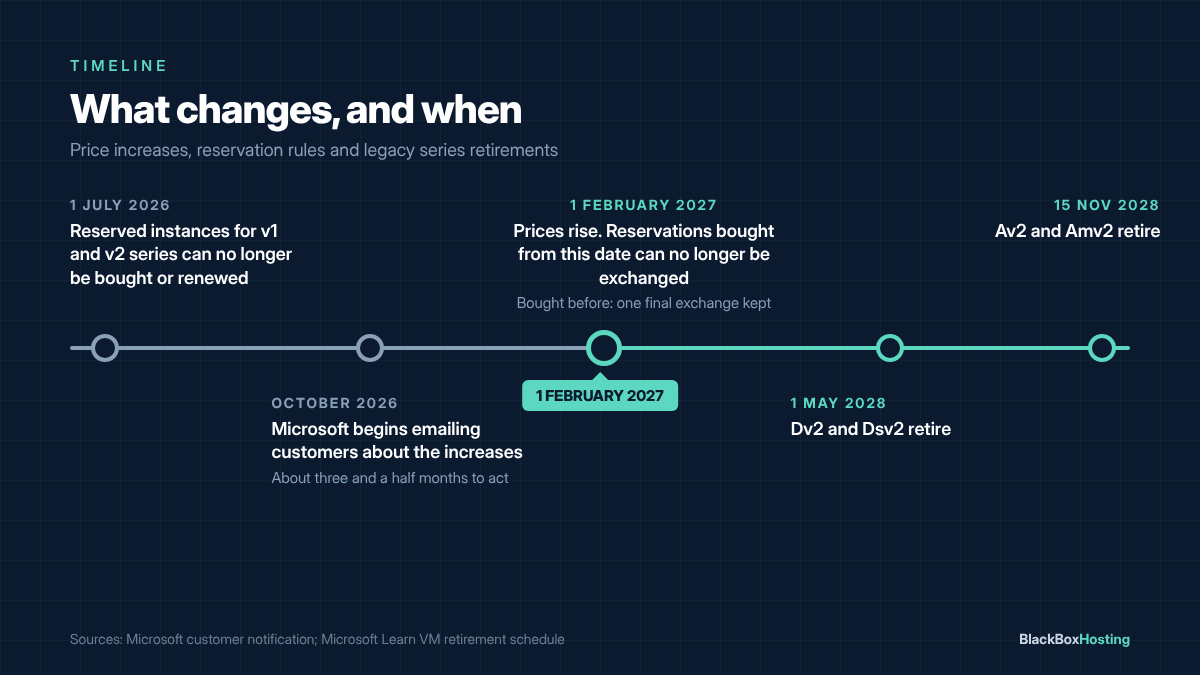
The legacy increase follows a retirement schedule already in motion. Microsoft ended reserved instance purchases and renewals for v1 and v2 series on 1 July 2026, with Dv2 and Dsv2 retiring on 1 May 2028 and Av2 and Amv2 following on 15 November 2028. A 25% increase more than a year before retirement is a clear financial nudge to migrate earlier.
Price rises like this are the cost of being a tenant on someone else’s roadmap. When a hyperscaler decides to retire a series or re-price a region, you absorb it or you migrate on their timetable. Fixed-price, UK-hosted private cloud exists precisely so that your infrastructure costs are something you agree, not something you are told.
Matt Burden, Founder and CEO, BlackBox Hosting
How does the increase affect Azure reservations and savings plans?
It depends on how each VM is billed today.
- Pay-as-you-go, Enterprise Agreement and Microsoft Customer Agreement rates take the full increase on 1 February 2027.
- Existing reservations and savings plans: Microsoft’s regional notice does not state how in-flight commitments are treated. Confirm with your Microsoft account team or CSP before assuming they are protected until renewal.
- v1 and v2 workloads have fewer options. Reservations for those series can no longer be bought or renewed, so the old price cannot be locked in. The choices are a savings plan, which may reprice, or moving to a newer series.
The exchange rule raises the stakes on timing. A reservation bought before 1 February 2027 keeps the right to one final exchange after that date. One bought on or after 1 February cannot be exchanged at all. If you are going to commit, commit before February, and only to series and regions you are confident you will still be running in three years.
What should UK businesses do before 1 February 2027?
There are about three and a half months to act. The decisions interact, so work through them in order:
- Inventory: list every VM by series and region and every storage account by region. Flag anything on v1 or v2, or in Dublin, Amsterdam, France, Norway or Singapore.
- Quantify: apply the percentages to last month’s bill for the flagged resources. This is your February uplift. Add the retirement dates for v1 and v2 so finance can see that the 25% is a bridge, not a destination.
- Decide per workload: migrate to a newer series, move region, re-commit before February, or move off Azure entirely for workloads that do not need hyperscaler-specific services.
- Review commitments: anything you intend to reserve should be bought before 1 February 2027 while exchanges are still possible.
- Benchmark alternatives: for steady-state workloads such as line-of-business applications, databases, virtual desktops and file servers, a fixed-price UK private cloud will often come in below the new Azure rate, with no exposure to the next regional adjustment.
Key takeaway
Inventory first, then quantify, then decide workload by workload. Any reservation you plan to buy should be bought before 1 February 2027, and only for series and regions you are certain about.
Is a UK sovereign cloud a cheaper alternative to Azure?
For a large share of enterprise workloads, yes. Hyperscaler pricing is built for elastic, bursty demand. Most UK organisations run predictable workloads that sit at roughly the same size month after month, which is where metered pricing, regional adjustments and series retirements cost the most and deliver the least.
BlackBox Hosting’s managed private cloud is hosted and operated entirely in the UK on a transparent fixed-price model. Independent benchmarking of our platform against AWS found it 36% faster and 48% cheaper for comparable workloads. Because the infrastructure is dedicated rather than shared, there is no equivalent of a regional re-price or a forced series retirement: the price you agree is the price you pay for the term.
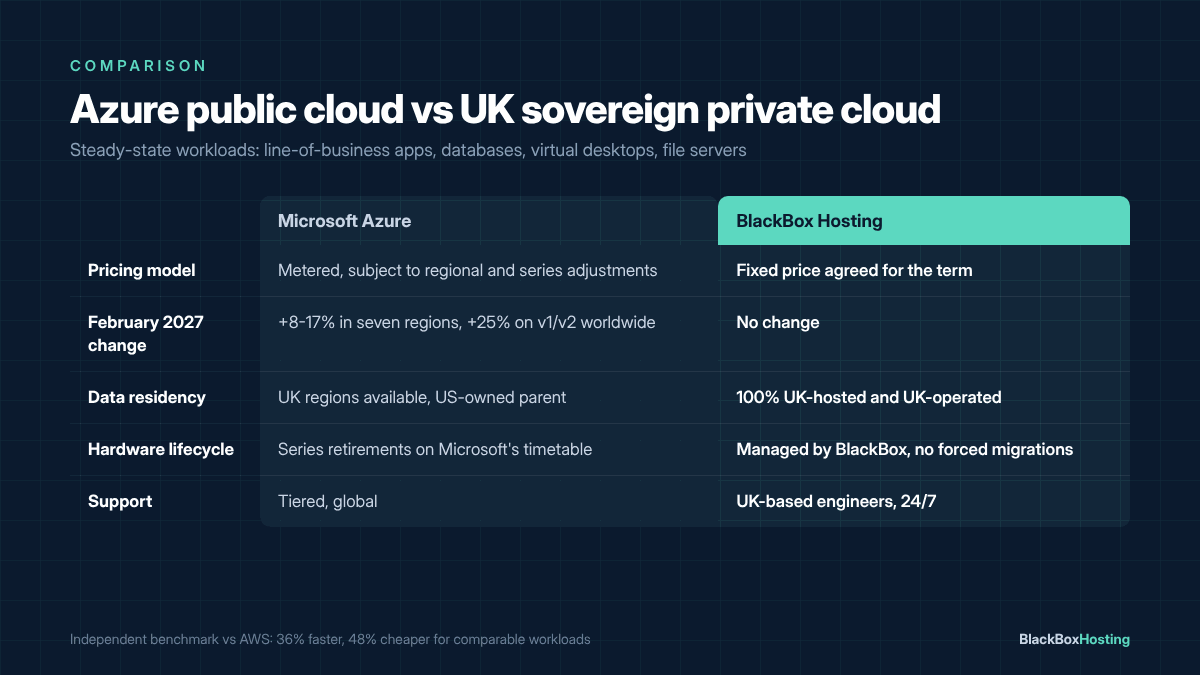
| Microsoft Azure | BlackBox Hosting | |
|---|---|---|
| Pricing model | Metered, subject to regional and series adjustments | Fixed price agreed for the term |
| February 2027 change | +8-17% in seven regions, +25% on v1/v2 worldwide | No change |
| Data residency | UK regions available, US-owned parent | 100% UK-hosted and UK-operated |
| Hardware lifecycle | Series retirements on Microsoft’s timetable | Managed by BlackBox, no forced migrations |
| Support | Tiered, global | UK-based engineers, 24/7 |
The sovereignty point is worth stating plainly. UK data held in a UK Azure region is still subject to US legislation such as the CLOUD Act because the operator is a US company. A UK-owned, UK-operated provider is not. For regulated sectors, that is often the deciding factor before cost is even considered.
If you want to understand what the February increase will cost your estate, and what the same workloads would cost on fixed-price UK infrastructure, BlackBox will run the comparison for you. Book a free consultation and bring your Azure bill.
Frequently asked questions
The increases take effect on 1 February 2027. Microsoft began notifying customers by email in early October 2026.
Seven regions: EU North (Dublin) +17%, France Central +11%, France South +11%, EU West (Amsterdam) +9%, Norway East +9%, Norway West +9% and Southeast Asia (Singapore) +8%. The increase applies to VMs and most storage in those regions.
They are not on the regional increase list. However, the 25% increase on v1 and v2 VM series applies in every region worldwide, including the UK, and many UK organisations run workloads in Dublin or Amsterdam that will be affected.
The v1 series (Bv1, D, Ds, F, Fs, G, Gs, Ls, NP and HC) and the v2 series (Av2, Amv2, Dv2, Dsv2, Fsv2 and Lsv2). The increase applies in all regions.
Microsoft’s regional notice does not say how existing reservations are treated. Pay-as-you-go, EA and MCA rates take the full increase. Confirm the treatment of in-flight reservations and savings plans with your Microsoft account team before assuming you are protected.
Reservations bought on or after 1 February 2027 can no longer be exchanged. Reservations bought before that date keep the right to one final exchange. Trading a reservation in for a savings plan remains available.
Yes. BlackBox Hosting provides UK-hosted, UK-operated managed private cloud on a fixed-price model, so there are no regional re-prices or forced series retirements. Independent benchmarking found the platform 36% faster and 48% cheaper than AWS for comparable workloads.