

Microsoft has removed the cost penalty for leaving Azure in the UK. Here’s exactly what changed, who qualifies, and how it compares to switching to a UK sovereign cloud provider.
As of 1 June 2026, Microsoft’s UK Azure Services Switching and Multicloud Addendum credits UK Azure customers for data egress fees when they export data to switch cloud providers, for up to 180 days once the claim is submitted. It follows commitments Microsoft made to the UK Competition and Markets Authority (CMA) to remove barriers to multicloud adoption and switching.
Quick Reference
- Effective date: 1 June 2026
- What it covers: Credits for egress fees when exporting Azure data (EDDA) to switch cloud providers
- Who qualifies: UK-billed customers on UK-hosted Azure workloads, via a CSP or Enterprise Agreement (EA)
- Claim window: Up to 180 days once the credit request is submitted
- How to claim: Your CSP partner or EA account team submits the request through Azure Support
- Why now: Follows Microsoft’s March 2026 voluntary commitments to the UK Competition and Markets Authority
What Is the UK Azure Services Switching and Multicloud Addendum?
The UK Azure Services Switching and Multicloud Addendum is a contractual addendum to Microsoft’s Products and Services Data Protection Addendum (DPA), which took effect on 1 June 2026. It applies only to UK-hosted Azure services and does not extend or modify the EU Data Act’s existing switching rules.
It is Microsoft’s contractual response to a UK Competition and Markets Authority (CMA) cloud market investigation. In March 2026, the CMA accepted voluntary commitments from Microsoft and AWS on egress fees and switching, rather than opening a formal Strategic Market Status investigation into the cloud market. The Addendum is how Microsoft has written those commitments into its UK contracts.
Does This Mean Azure No Longer Charges Egress Fees?
Not exactly, and this is the detail worth getting right before repeating it to a client or prospect. Azure still applies egress charges when data leaves the platform. What changes is that UK-billed customers with UK-hosted workloads can now claim a credit for those charges when the export is for switching purposes, covering exports made either over the public internet or through the Microsoft Premium Global Network (MGN).
The credit has to be actively requested, and it is time-bound: Microsoft applies it for up to 180 days once a partner submits the request with Azure Support on the customer’s behalf. It is not an automatic, blanket waiver applied at the point of export.
Who Qualifies for the Egress Fee Credit?
The Addendum applies specifically to customers who are billed in the UK and using Azure datacentres in the UK, meaning both the billing entity and the hosted workload need to be UK-based. It covers customers purchasing through either a Cloud Solution Provider (CSP) or an Enterprise Agreement (EA).
How Do You Actually Claim It?
The request has to be submitted by the CSP partner or the EA account team on the customer’s behalf, not by the end customer directly. For new customers, the terms are already built in: EA customers get the Addendum as a separate contract amendment, and CSP customers purchasing via the Microsoft Customer Agreement (MCA) get it as part of the core MCA terms.
For existing customers, EA accounts can add the Addendum through amendment M1303 (“Data Protection Addendum for International Data Transfer and Country-Specific Terms”) in Volume Licensing Central. Existing CSP customers on the MCA don’t need to do anything: the terms apply automatically, either at their next transaction or 60 days after Microsoft’s notice, whichever comes first.
Why Is Microsoft Doing This Now?
This sits inside a broader regulatory story. Rather than open a full Strategic Market Status investigation into cloud, the CMA accepted voluntary commitments from both Microsoft and AWS in March 2026 covering egress fees, switching, and interoperability. As part of that, Microsoft extended its free-switch window from 60 to 180 days and broadened what counts as a qualifying “switch”: customers can now claim the credit when exiting a single Azure service, not only when leaving Azure entirely.
The CMA has said it will review progress on switching and multi-homing again in six months, so this is unlikely to be the last change UK businesses see in this space.
What This Means If You’re Planning to Move Off Azure
Removing the cost penalty for leaving is a genuine, practical change: it takes a line item off the migration business case that many IT and finance teams have flagged as a blocker. But it is worth being clear-eyed about what it does and doesn’t solve. It reduces the cost of exit. It doesn’t change where your data sits while it’s on Azure, who can be compelled to access it, or what the ongoing cost of running workloads there looks like compared with an alternative.
On cost and performance specifically, BlackBox’s 2026 SQL Server benchmarking against Azure found BlackBox delivering 127,271 NOPM against Azure’s 57,546 NOPM on an equivalent instance, over double the transactional throughput, at roughly half the cost. And BlackBox’s pricing has never included egress fees in the first place, so there’s no credit to request and no 180-day window to work inside: it’s a fixed monthly cost from day one.
For UK organisations already required to demonstrate data sovereignty (financial services under FCA rules, healthcare under NHS DSPT, public sector buyers via G-Cloud), the destination matters as much as the exit cost. A UK sovereign cloud hosting provider keeps both the data and the legal governance of that data inside UK jurisdiction, which a UK region of a US hyperscaler does not — the same principle applies whether you’re moving SQL workloads, sovereign cloud data, or dedicated private server infrastructure.
Leaving Azure: Before vs After the Addendum
| Before 1 June 2026 | After 1 June 2026 (with Addendum) | |
|---|---|---|
| Egress fees on exit | Charged in full, no credit | Credited back, up to 180 days, on request |
| Qualifying “switch” | Full Azure account exit only | Single-service exit also qualifies |
| Who requests it | N/A | CSP partner or EA account team, on the customer’s behalf |
| Who qualifies | N/A | UK-billed customers, UK-hosted workloads only |
Azure (With the Addendum) vs BlackBox on Egress Cost
| Azure | BlackBox Hosting | |
|---|---|---|
| Egress fees | Charged, then credited on request | Never charged |
| Claim process | Partner request via Azure Support required | None needed |
| Credit window | 180 days from request | N/A, always £0 |
| Eligibility | UK-billed, UK-hosted workloads only | All BlackBox customers |
Key Takeaway
Microsoft’s Addendum removes the cost penalty for leaving Azure, but only for UK-billed, UK-hosted workloads, only for 180 days from the date a partner requests it, and only once it’s actively claimed. It lowers the cost of exit. It doesn’t change data jurisdiction, ongoing running cost, or performance, which is where the comparison with a UK sovereign cloud provider actually plays out.
Steps to Claim Your Azure Egress Fee Credit Before You Switch
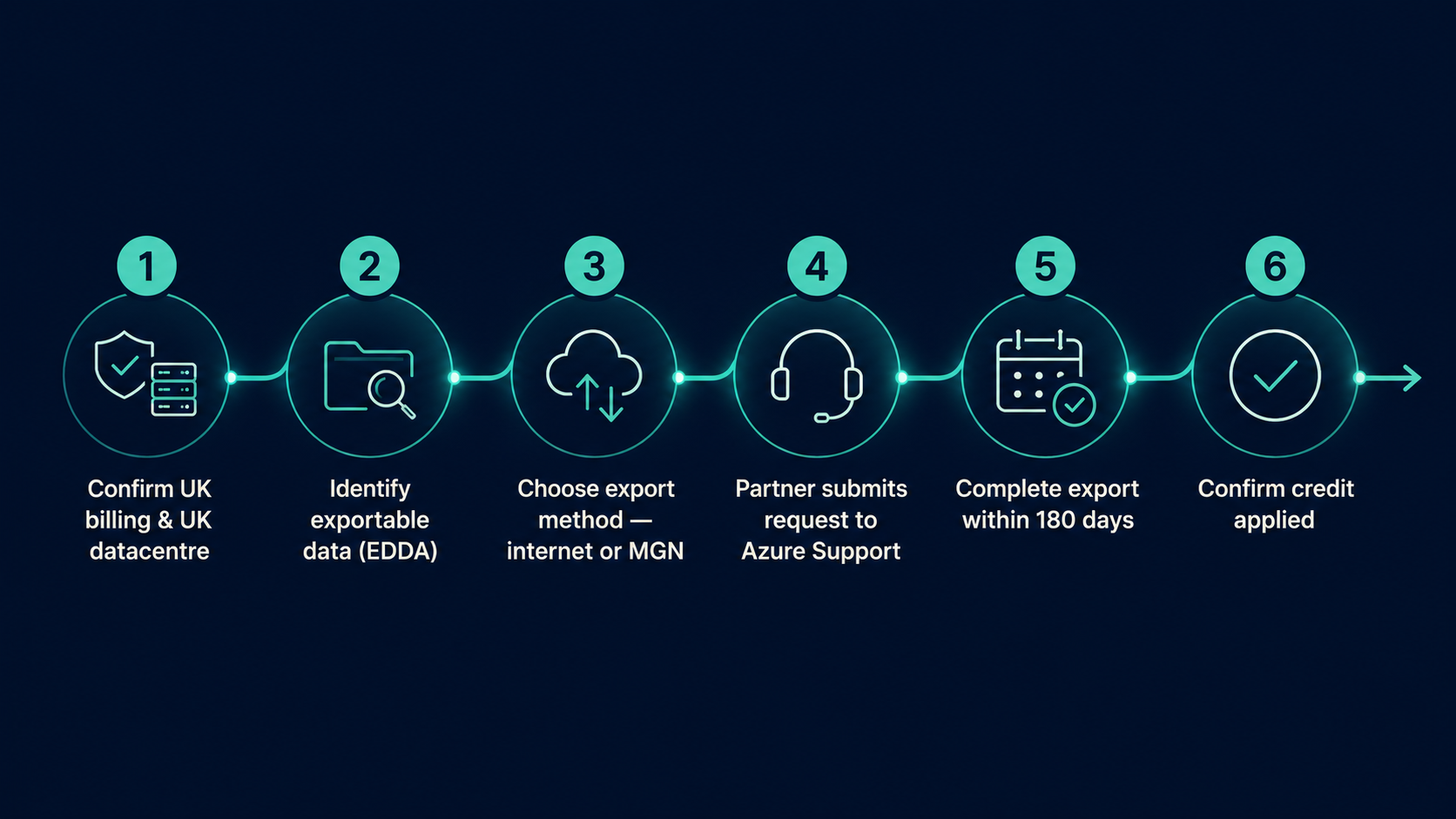
| 1 | Confirm your billing entity and workloads are UK Azure: UK billing address and UK datacentre region |
| 2 | Identify the exportable data and digital assets (EDDA) in scope for the move |
| 3 | Choose your export method: public internet egress or the Microsoft Premium Global Network (MGN) |
| 4 | Ask your CSP partner, or your EA account team, to submit the credit request with Azure Support |
| 5 | Complete the data export within the 180-day window from the date of the request |
| 6 | Confirm the credit has been applied to your account or invoice before closing out the old environment |
BlackBox Hosting’s Certifications
- ISO 27001 (information security), ISO 22301 (business continuity), ISO 20000-1, ISO 9001, ISO 14001, and ISO 14068-1:2023 (carbon neutral)
- CSA STAR Level 2 and Cyber Essentials Plus
- G-Cloud 14 listed on the Crown Commercial Service Digital Marketplace
- UK-incorporated, UK-owned and operated, with no exposure to the US CLOUD Act
“Microsoft removing the cost penalty for leaving Azure is a good, overdue change for UK businesses. But it doesn’t touch the underlying question every regulated organisation eventually has to answer: whose law governs your data while it’s sitting on that platform. That’s the conversation we have with almost every business that talks to us about moving off Azure, and it’s a different question to the one this Addendum answers.”
Frequently Asked Questions
What is the UK Azure Services Switching and Multicloud Addendum?
It’s a contractual addendum to Microsoft’s Products and Services Data Protection Addendum, effective 1 June 2026, that credits UK Azure customers for data egress fees when they export UK-hosted data to switch cloud providers. It was introduced as part of Microsoft’s commitments to the UK Competition and Markets Authority.
Does this mean Azure no longer charges egress fees at all?
No. Azure still charges egress fees. Qualifying UK customers can claim a credit for those fees when exporting data to switch providers, for up to 180 days once the request is submitted. It is a credit that has to be claimed, not an automatic waiver.
Who qualifies for the Azure egress fee credit?
Customers who are billed in the UK and running Azure workloads in UK datacentres, purchasing either through a Cloud Solution Provider (CSP) or an Enterprise Agreement (EA).
How do I claim the credit before switching away from Azure?
Your CSP partner or your EA account team needs to submit the request with Azure Support on your behalf. The export itself must be completed within 180 days of that request being submitted.
Why did Microsoft introduce this now?
It follows a UK CMA cloud market investigation. In March 2026, the CMA accepted voluntary commitments from Microsoft and AWS on egress fees, switching, and interoperability rather than opening a full Strategic Market Status investigation. The Addendum is Microsoft’s contractual implementation of those commitments.
Does the Addendum cover EU-hosted Azure data too?
No. It applies only to UK-hosted Azure services and does not extend or modify existing EU Data Act obligations, which separately require cloud providers to remove switching fees from 2027.
If Azure’s egress fees can now be credited, is there still a cost advantage to switching to a UK provider like BlackBox?
The egress credit only covers the cost of leaving, and only within a 180-day claim window. It doesn’t change the ongoing running cost of the workload. BlackBox’s 2026 SQL Server benchmarking against Azure found roughly double the transactional throughput at around half the cost, with no egress fees at any point, so the comparison is really about running cost and data jurisdiction rather than exit cost alone.
Sources: Microsoft’s United Kingdom Azure Services Switching and Multicloud Addendum notice; UK Competition and Markets Authority cloud market investigation coverage (Steptoe, The Register); BlackBox Hosting 2026 SQL Server benchmarking.
